
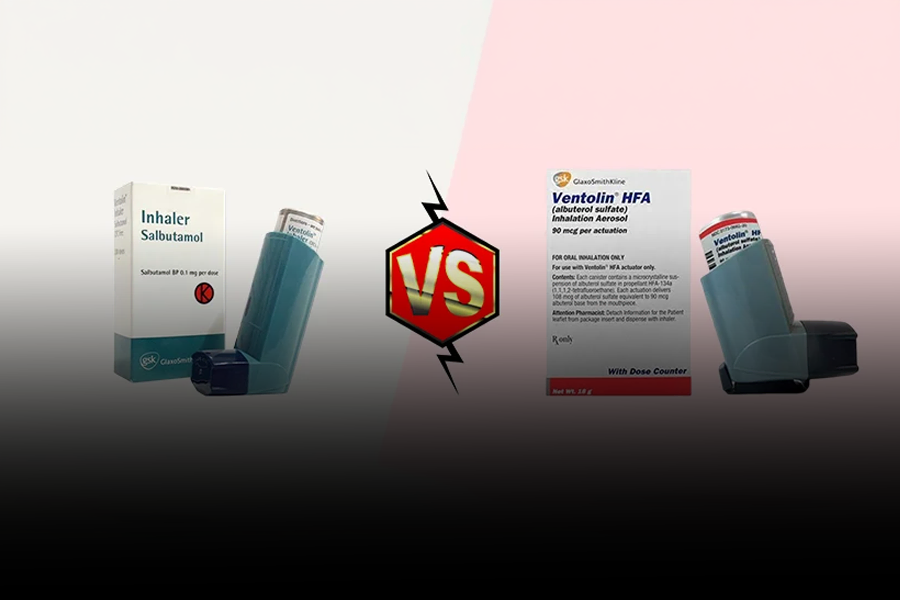
So, if you’ve ever traveled out of your country with asthma or went to grab a prescription somewhere else, you might’ve noticed this weird thing: your regular inhaler suddenly has a totally different name on the box. It makes you think, “wait… is this a new med?” or something, but usually it’s not. This is the exact confusion a lot of patients run into when they compare salbutamol vs albuterol. They sound like separate drugs, yet the whole story is way simpler than people assume. In what follows, we’ll sort out what salbutamol and albuterol really are, how they behave in your body, whether you can swap them, and what to keep in mind if you’re ever asked to switch from one label to the other.
Overview: Salbutamol vs Albuterol
What Is Salbutamol?
Salbutamol is a short-acting beta-2 agonist, or SABA for short, and it’s used to relax the airway muscles so breathing gets easier, especially during an asthma attack or a flare-up in chronic obstructive pulmonary disease (COPD). Most people get it via a metered-dose inhaler or a nebulizer solution, and in some places, less often, it shows up as tablets or syrup. Salbutamol is the International Nonproprietary Name (INN) for the medication, which is why you’ll see that word most frequently on packaging in the United Kingdom, Europe, Australia, and many other regions. Brand names you might recognize include Ventolin, Salamol, and Airomir, though the exact names vary depending on where you live.
What Is Albuterol?
Albuterol is, chemically and pharmacologically, the exact same compound as salbutamol. The “difference” is basically naming style, not composition. Albuterol is the United States Adopted Name (USAN), which is why it’s the term used pretty much everywhere in the United States and Canada. Just like salbutamol, it can come as an inhaler, a nebulizer solution, and an oral form. In the U.S., it’s often sold under well-known brand names like Ventolin HFA, ProAir HFA, and Proventil HFA. If you’ve wondered why American pharmacies never seem to carry something literally called “salbutamol,” this split in naming explains it.
Salbutamol vs Albuterol: Are They The Same Medication?
Yes. This is one of the most asked questions online on Salbutamol vs albuterol, and the answer is pretty direct. Is salbutamol the same drug as albuterol? Chemically speaking, they match the same active molecule, the same mechanism of action, and the same expected therapeutic effect. The reason they look different on paper comes down to regional naming standards. Over the years, regulatory bodies in different countries picked different official names, and manufacturers kept using whatever term was “standard” for their market. So if you’re given an inhaler labeled “salbutamol” in London or one labeled “albuterol” in New York, you’re usually dealing with the same medicine with the same active ingredient at equivalent doses.
Salbutamol vs Albuterol: Key Differences
Since the drug itself is the same, what changes tends to be administrative and regional, not clinical:
- Naming standard:
Salbutamol is tied to the INN naming system, while albuterol follows the USAN system.
- Packaging and branding:
The same manufacturer may market something essentially identical under different brand labels depending on the country.
- Formulation details:
Some regional versions may vary slightly in things like propellant type (for example, older CFC-based inhalers compared with newer HFA-based inhalers ), along with inactive ingredients or the device design. Those are manufacturing differences, not true differences in the drug itself.
- Salbutamol vs albuterol onset of action:
People ask how salbutamol works and how albuterol works. Both versions typically start working within minutes after inhalation, and many people notice relief around 5 to 15 minutes, with effects lasting about 4 to 6 hours. There’s no real, meaningful clinical difference in speed between the two “named” versions because the active compound is identical.
In short, the salbutamol and albuterol difference is geography and labeling, not chemistry or performance.
Conditions Treated with Salbutamol and Albuterol
Salbutamol vs albuterol refer to the same kind of medication, used for the same respiratory situations, such as
- Acute asthma attacks, and sudden asthma symptom flare-ups
- Exercise-induced bronchospasm
- Breathing difficulty linked to COPD
- Wheezing that shows up with bronchitis or other reactive airway issues
Clinicians usually position it as a fast “rescue” option rather than a long-term controller medicine, meaning it’s meant to calm sudden symptoms, not prevent them day after day.
Common Benefits of Salbutamol vs Albuterol
Since they’re just different labels for the same medicine, the benefits overlap completely.
Salbutamol benefits include quick relief of airway tightening, portable inhaler options, and a long history of safety based on decades of global use.
Albuterol benefits are rapid symptom relief and convenient dosing by inhaler or nebulizer, and it can be used for adults and children when it’s recommended appropriately.
Both versions are considered first-line rescue treatments by respiratory specialists worldwide. That’s mostly because the onset is fast and the results are predictable when you’re dealing with sudden breathing problems.
Salbutamol vs Albuterol: Possible Side Effects
Because the active ingredient is basically the same, the side effect picture doesn’t really change much between the two.
Most people notice common salbutamol side effects like a light tremor (mostly in the hands), a faster heart rate, headache, feeling jumpy or nervous, and sometimes muscle cramps.
Common albuterol side effects track along pretty closely too, like tremor, palpitations, throat irritation, dizziness, and, in a few situations, a temporary rise in blood pressure.
Usually these side effects are mild and fade pretty quickly once the medication effect starts wearing off.
Can You Switch Between Salbutamol and Albuterol?
Switching from salbutamol to albuterol, or the other way around, is generally seen as safe and often unavoidable if someone moves, travels abroad, or ends up picking up prescriptions in another country. In salbutamol vs albuterol, they are the same molecule. Most healthcare providers and pharmacists treat them like direct equivalents in terms of dosing and therapeutic effect.
That said, a few practical things are worth keeping in mind about salbutamol vs albuterol:
- Device style and mechanisms may differ a bit from brand to brand, so it’s smart to look at the new inhaler instructions, even if the drug inside doesn’t change.
- The strength per puff can shift slightly between brand formulations, so double-checking the label or asking a pharmacist is a very reasonable backup plan.
- If the switch is travel-related, it’s smart to confirm with a local pharmacist that what you’re getting is truly the equivalent medication before you depend on it in a hurry.
So, are salbutamol and albuterol interchangeable? For the vast majority of patients, yes. They’re considered therapeutically equivalent, and switching with guidance from a clinician or pharmacist is routine worldwide.
Summing Up
In the end, the whole salbutamol vs albuterol question isn’t really about two distinct medications. It’s more of a naming story that changes depending on the country. Salbutamol and albuterol are the same active compound, used for the same conditions, with similar onset, benefits, and side effect patterns. Whether your inhaler label says one name or the other mostly depends on where it was made and sold. If you’re traveling or relocating, or you’re simply checking the wording on your healthcare provider’s instructions, you can generally feel confident that switching is about the label, not chemistry. Still, it’s always a good move to confirm with a healthcare provider or pharmacist about your specific device and dose.
FAQs
1. Is salbutamol stronger than albuterol?
No. Since salbutamol and albuterol are the same drug, neither is automatically “stronger” than the other. If one feels more intense, it’s usually tied to the exact dose or the formulation in that product, not the name.
2. Why do US and other countries have different names for the same drug?
The reason is the naming system. The USA uses United States Adopted Name (USAN) approaches. On the other hand, other countries use the International Nonproprietary Name (INN) approach.
3. Do you have an albuterol inhaler that you can use instead of Salbutamol?
Yes, because it is the same medication. Salbutamol vs albuterol: the doses, type of inhaler, and brand do not correspond.
4. Are salbutamol and albuterol the same?
Yes, same active ingredient and same results. But exact dosing can vary a little by brand and formulation.
5. Are there any differences in how salbutamol and albuterol are stored or handled?
Storage needs are usually comparable for both, because they depend more on the inhaler device and formulation (like the type of propellant) than on what name appears on the box. Always review the manufacturer’s storage instructions for your exact product packaging.