
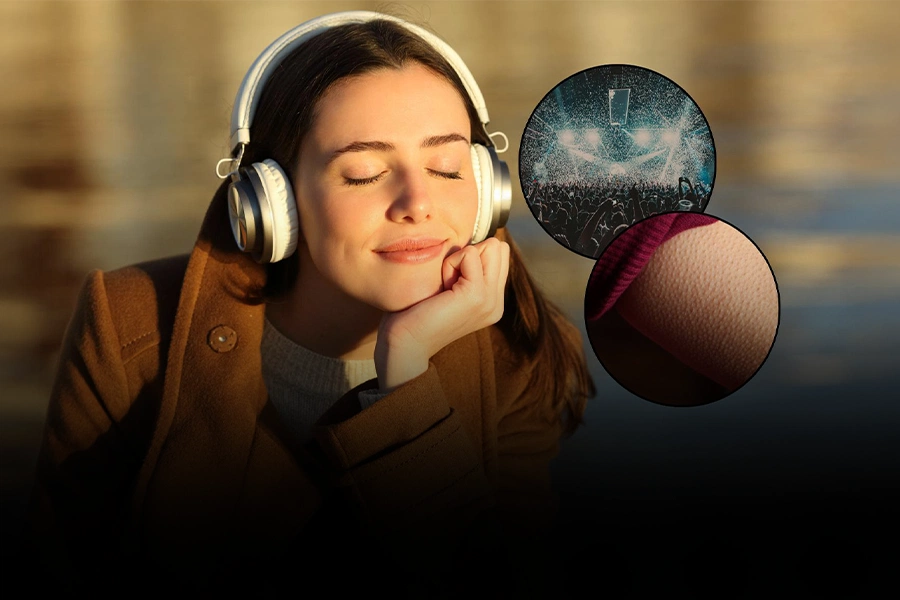
You’re driving, minding your own business, and then a song hits its chorus; suddenly your arms are doing that whole goosebumps thing. Or maybe it’s a swelling orchestral beat in a movie, or a singer is just nailing a note so clean it feels like your chest is tightening up. And yeah, that reaction kind of has a name, musical frisson. Brain science is one of the more interesting things people study when they’re trying to understand emotion in the brain. But why, like, honestly, does a pattern of sound waves (something that has no calories, no danger, and no obvious “help you survive” benefit) make your body react like something huge just happened? The answer is in the wiring, and it turns out music chills. Science overlaps in a surprising way with the neuroscience of food, sex, and drugs too.
Goosebumps on Command: What Exactly Is Frisson?
“Frisson” (free-SON) is the term researchers use for that skin-tingling, hair-raising sensation that shows up during an emotionally intense moment in music. Not everyone gets it, though; studies suggest something like 55 to 86% of people report it depending on the study and how they measure frisson. Still, for the people who do , it feels pretty repeatable. Usually, brain science happens when there’s an unexpected chord switch, a sudden volume shift, a voice that cracks with real feeling, or that long-awaited musical payoff after a long stretch of buildup. Musical frisson isn’t only a pretty phrase; it’s a real physiological event with measurable changes like skin conductance, shifts in heart activity, and the literal goosebumps part (piloerection) that scientists can log in controlled lab conditions.
Your Brain on a Beat Drop: The Dopamine Connection
Here’s where it starts getting actually wild. When researchers used brain science on people while they listened to music that gave them chills, they saw activation in the reward circuits that usually light up for eating, sex, and drug use. This is basically the core of the dopamine music reward system. A landmark study from McGill University found that dopamine, the brain’s “feel-good” neurotransmitter, shows up in two separate waves. One spike happens in the caudate nucleus during the anticipation of a musical peak, like that buildup of tension right before the chorus drops. Then, the second spike hits the nucleus accumbens at the real emotional climax of the song. So your brain is kind of rewarding you twice, first for waiting and then for the payoff itself.
Related : Role of Neurotransmitters: Dopamine, Norepinephrine & Orexin
Prediction, Surprise, and the Brain’s Love of Getting It (Almost) Right
So why does anticipation matter this much? This is where music, emotion, and psychology get kind of fascinating. Your brain science is always trying to predict what comes next in talk, in movement, and especially in music. When you know a familiar genre, or even just a common song structure, your brain starts building expectations about melody, rhythm, and harmony. Moments that cause frisson tend to show up when the music breaks those expectations just enough to catch you off guard and then resolves them in a satisfying way. A slightly delayed beat, a modulation into a not-expected key, or a sudden entrance of full orchestration can create that tension-and-release combo that feels perfect, almost like the music is teasing you.
Composers and songwriters may not study neural circuits directly, but they’ve basically internalized this logic for centuries, from Baroque suspensions to pop music’s key change before the final chorus. They don’t need the science language to hit the same effect.
Mapping the Musical Mind: How the Brain Responds to Sound
To understand the full brain music response, you can’t just stare at the reward system. Music tends to light up a surprisingly broad network of regions at the same time. You’ll see activity in brain science like the following:
- Auditory cortex, which handles pitch, tone, and rhythm
- Amygdala, tied to emotional intensity and threat or reward evaluation
- Hippocampus, linking music with memory, which helps explain why old songs can feel so loaded emotionally
- Motor regions, activating even if you’re sitting still, which is part of why music makes you want to move
- Prefrontal cortex, involved in anticipation, pattern recognition, and aesthetic judgment
This widespread activation is a huge part of why music feels so uniquely powerful compared to other everyday sounds. Not many normal experiences can flip on so many separate brain sciences at once, and that’s why the neuroscience of music keeps being such a deep, ongoing research area.
Related: Benefits of Sleep Meditation Music
More Than Just Feel-Good: The Emotional Undercurrent
Even though chills get linked to joy or awe a lot, the emotional response music creates is way more layered than “happy = chills.” Sad songs can trigger frisson too. Sometimes, it connects to nostalgia, catharsis, or that bittersweet kind of reflection. Some researchers describe brain science as “pleasurable sadness,” which is kind of paradoxical, because music lets people experience intense emotion without the usual real-world fallout. That’s a big piece of music emotion psychology: songs work a little like emotional practice runs, giving your brain a safe rehearsal space where feelings can rise and then release without turning into a high-stakes situation. It’s one reason a breakup playlist can end up feeling oddly comforting, not just purely painful.
Not Everyone Gets Chills
Like, goosebumps music science. People who get frisson usually end up scoring higher on the trait “openness to experience,” which is one of the Big Five things in psychology. And brain science shows that folks who are more likely to get frisson might have some structural differences in the white matter, connecting their auditory cortex to emotional processing areas. That, in theory, could mean more efficient communication between the brain bits that handle sound and the bits that handle feeling. So when a friend says they’ve never gotten chills from a song, it’s not necessarily that they’re “less emotional” or anything; their brain wiring for this reward-ish reaction could just be a little different… more or less responsive, depending.
Why Your Brain Keeps Rewarding You for Sound
Evolution-wise, this reward system around music is puzzling because music doesn’t directly help you survive the way food does, or even social bonding does. One idea is that music “borrows” brain pathways that originally evolved for vocal communication, social attachment, and emotional signaling. Singing together along with rhythmic moving around maybe historically strengthened group cohesion, so the music reward could be a side effect of something that made connections feel really good. Still, whatever the original function was, the outcome now is that a three-minute song can spark the same sort of reward chemistry as experiences that feel way more survival-related.
Brief To Conclude
The next time a song gives you chills, you’re basically watching your brain do a quick little neurological routine like prediction, surprise, memory, and reward all kicking in around the same few seconds. The brain science behind musical frisson makes it clear we’re deeply tuned to sound patterns and how those patterns can become emotionally important. Whether brain science is a dopamine rush from a perfectly timed chorus or an amygdala-leaning nostalgia wave, those goosebumps are like proof that music can do something pretty rare: it takes abstract sound patterns and turns them into full-body emotion.
FAQs
1. Why do only certain songs give you chills and not others?
Frisson tends to show up when a song creates anticipation, then follows with an unexpected or emotionally strong resolution. And since brain science is tied to personal musical familiarity and taste, the exact songs that cause chills vary a lot from person to person.
2. Is it normal to never get chills from music?
Yeah, it’s totally normal. Studies suggest a notable chunk of the population doesn’t experience frisson, and that might relate more to personality factors and individual brain science connectivity differences, not to a lack of emotional sensitivity.
3. Do music and dopamine come under psychology and neuroscience?
Yes, music and dopamine keep coming up in psychology and neuroscience discussions. This is part of brain science. It shifts the idea of music from background noise to an active trigger for one of the most powerful reward pathways your brain runs.
4. Does music matter for triggering a dopamine response?
Not really. Frisson and the related dopamine response have been reported across genres, from classical and orchestral to rock, pop, and film scores. What seems to matter most is the structure of anticipation and release, not the genre name on the playlist.
5. Why do sad songs give people chills too?
Sad music can trigger a layered emotional reaction that’s often described as “pleasurable sadness.” Basically, the brain processes emotional depth in a safe, controlled setting, so people can get catharsis along with physical sensations like chills.