
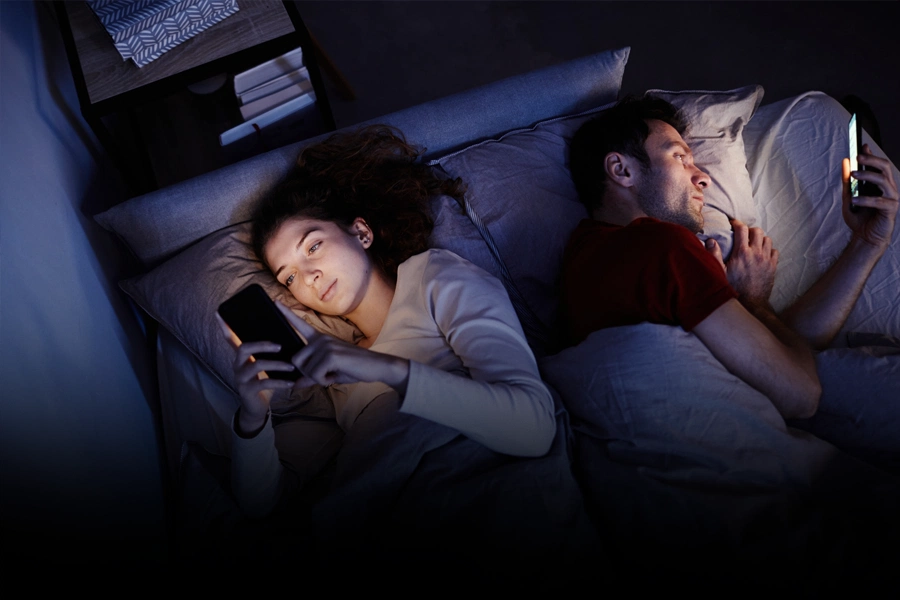
It’s 11:30 PM. The house is quiet, the pillows are propped up just right, and you’re lying next to the person you love. But you aren’t looking at them. You’re looking at a glowing rectangle of glass, scrolling through a feed of strangers’ vacations, political arguments, or perhaps a mindless loop of “satisfying” rug-cleaning videos.
We’ve all been there. It feels harmless, right? A little wind-down time. But as a health journalist who’s spent the last decade peering into the messy intersection of lifestyle and biology, I’ve started to notice a pattern in the data-and in the hushed conversations people have when they think no one is listening. Our devices aren’t just stealing our sleep; they are fundamentally retooling our intimacy.
The reality is that screen time affects sexual stamina in ways that the glossy tech commercials never mention. We talk about “digital detox” for our focus or our posture, but we rarely talk about it for our bedrooms.
The Invisible Third Party in Your Bed
There’s a specific kind of exhaustion that comes from high-dopamine digital consumption. It’s not the “I just ran a 5k” tired; it’s a cognitive fog that leaves you physically present but emotionally checked out. When your brain is overstimulated by a constant stream of blue light and rapid-fire information, your nervous system gets stuck in a state of high-alert.
I remember talking to a urologist last year who told me he’s seeing more men in their twenties and thirties than ever before complaining about “performance fatigue.” It’s not always a plumbing issue. Often, it’s a wiring issue. The way screen time affects sexual stamina is rooted in how we process reward. If you spend four hours “winning” at a video game or getting hits of dopamine from social media likes, your brain feels “rewarded” without you ever having to engage in the physical, vulnerable effort of sex.
In a way, our phones have become a surrogate for intimacy. They provide the hit without the work.
The Cortisol Spike and the Testosterone Dip
Let’s get into the weeds for a second. The blue light emitted by your phone doesn’t just keep you awake; it suppresses melatonin. When melatonin is low, cortisol (the stress hormone) often stays high. And as any endocrinologist will tell you, cortisol and testosterone are on a seesaw. When one goes up, the other usually takes a dive.
This hormonal imbalance is one of the primary erectile dysfunction causes and solutions often get overlooked because we’re too busy looking for a “magic pill.” While medications like Super Kamagra or combinations of Dapoxetine and Sildenafil are widely used and effective for clinical issues, they shouldn’t necessarily be the first line of defense if the root cause is that you’re spending six hours a day staring at a flickering screen.
I’ve seen guys spend a fortune on the best medicine for sexual stamina, only to realize that their bedroom environment was the actual problem. If your brain is wired to expect the hyper-stimulation of a screen, the slower, more rhythmic pace of real-life sex can feel… well, boring. That’s a terrifying thought, isn’t it? That we’ve “bored” our brains out of being able to stay present in our own bodies.
The “Death by a Thousand Scrolls”
It’s not just about the big “event” either. It’s the micro-interactions. Have you ever noticed how, when you’re on your phone, your breathing becomes shallow? We call it “email apnea.” This shallow breathing keeps you in a sympathetic nervous system state-fight or flight. You cannot be “in the mood” if your body thinks it’s running from a predator (even if that predator is just a stressful work email).
This persistent state of low-level stress is one of the major causes of low sexual stamina in men. When the body is stressed, it diverts blood flow to the heart and limbs, not the reproductive organs. It’s a survival mechanism. Your body doesn’t care about procreation or pleasure when it thinks you’re in a crisis.
And let’s be honest about the content we consume. The “comparison trap” is real. We are constantly bombarded with idealized versions of bodies and lives. This creates a subconscious “spectatoring” effect where, during sex, you aren’t feeling the moment-you’re judging how you look or perform against a digital standard that doesn’t exist. This mental overhead is exactly how screen time affects sexual stamina; it creates a brain that is too distracted to stay “in the game.”
The Biological Cost of Connectivity
There’s a deeper, more physical layer to this. I was reading a study recently on how screen time affects sperm quality, and the findings were a bit of a wake-up call. It’s not just the blue light; it’s the heat and the sedentary nature of our digital lives. Keeping a laptop on your lap or a phone in your pocket for hours on end can actually impact the temperature and health of your reproductive system.
When we look at excessive screen time effects on men, we have to consider the lack of movement. Testosterone is boosted by physical activity, heavy lifting, and real-world competition. If your only “activity” is moving your thumb an inch every few seconds, your endocrine system starts to go into a maintenance mode rather than a performance mode.
Is There a Fix?
I’m not a luddite. I like my iPhone as much as the next person. But we have to find a way to reclaim the “sacred space” of the bedroom. People often ask about natural ways to improve sexual stamina, and they expect me to list a bunch of obscure herbs or complicated exercises.
Actually, the most effective “biohack” I’ve found is simply leaving the phone in the kitchen after 9 PM.
It sounds too simple, right? But the shift is profound. When the screen goes away, you’re forced to deal with the silence. You’re forced to notice your partner. Your heart rate slows down. Your breathing deepens. You move from the “doing” brain to the “being” brain.
If you are currently looking for a treatment for low stamina in men, start by tracking your screen usage. If your “on-screen” hours are higher than your “out-of-the-house” hours, that’s your first clue. We have to train our nervous systems to be bored again. It is in that boredom that desire usually finds its way back to the surface.
The Psychological Drift
There’s also the issue of screen time and erectile dysfunction that is purely psychological. When we use screens to self-soothe-scrolling when we’re anxious, lonely, or tired-we lose the ability to use intimacy as a way to connect and de-stress. We become “digitally impotent” before we ever become physically so.
The connection between screen time affects sexual stamina and our mental health is a straight line. If you’re depressed because you’re comparing your life to Instagram influencers, your libido is going to take a hit. If you’re anxious because of the news cycle, your stamina will suffer.
I’ve talked to couples who realized that their “dead bedroom” wasn’t because they weren’t attracted to each other anymore; it was because they were both essentially “dating” their phones. They were giving their best, most alert energy to their followers and their bosses, leaving only the dregs for their partners.
Rethinking the Solution
If you’re struggling, it’s easy to feel like you’re broken. You might go searching for the best medicine for sexual stamina or start worrying about erectile dysfunction causes and solutions. And look, sometimes there is a medical need for intervention. There is no shame in that. But for a vast majority of us, the “glitch” is in our habits.
The way screen time affects sexual stamina is subtle at first. A little less focus here, a little less desire there. But over months and years, it adds up to a fundamental shift in how we experience pleasure.
We need to start looking at “analog time” as a form of foreplay. Going for a walk without headphones. Having a meal without a screen on the table. These things aren’t just “good habits”-they are the foundation of a functional sex life. They teach your brain that it doesn’t need a 100-watt glow to feel alive.
Final Thoughts from the Desk
I’m writing this on a laptop, which is the irony of being a modern writer. But as soon as I hit “save,” I’m going to close the lid. I’m going to go sit on my porch and just… look at the trees. Maybe I’ll talk to my wife.
We have to remember that our bodies are ancient. They haven’t evolved to handle the sheer volume of data we throw at them every day. Our sexual health is often the “canary in the coal mine”-the first thing to flicker when our lifestyle gets too out of sync with our biology.
If you feel like you’ve lost your edge, don’t just reach for a supplement. Look at the glow in your hand. The way screen time affects sexual stamina isn’t a permanent sentence, but it is a call to action. It’s a reminder that the most important connections in our lives don’t happen over Wi-Fi.
They happen in the dark, in the quiet, and in the physical presence of another human being. Don’t let a 5-inch screen take that away from you.
FAQs
- Is it just me, or does scrolling through TikTok actually make me less “in the mood”?
It’s definitely not just you. Think of your brain like a battery; every time you swipe, you’re spending a tiny bit of “arousal currency” on a joke, a recipe, or a headline. By the time you put the phone down to be intimate, your brain is functionally spent. This is exactly how screen time affects sexual stamina on a cognitive level-you’ve already hit your dopamine limit for the day. You aren’t “broken,” you’re just overstimulated.
2. Can my phone actually cause physical issues downstairs?
It sounds like a sci-fi horror plot, but there’s some truth to it. Beyond the psychological distractions, the sedentary “tech hunch” and the heat from devices can mess with circulation. When we discuss screen time and erectile dysfunction, we’re often talking about a body that has forgotten how to relax into a parasympathetic state. If your nervous system is always “on” because of work pings, your physical response will be “off.”
3. I’ve heard about “blue light” affecting sleep, but does it really hit my performance too?
Absolutely. It’s a domino effect. Blue light kills melatonin, which ruins your deep sleep. Deep sleep is when your body naturally produces the most testosterone. If you’re short-changing your sleep to watch “one more video,” you’re essentially tanking your own hormone levels. This is one of the most overlooked causes of low sexual stamina in men. Better sleep usually equals better stamina, period.
4. Are there any quick fixes or meds that actually work if the damage is done?
If things have reached a clinical point, there are options. Many men look into treatment for low stamina in men that involves pharmaceutical help. Medications like Super Kamagra or the combination of Dapoxetine and Sildenafil are common tools for managing the physical side of things. However, even the best meds can’t fix a relationship that’s being neglected for a screen. They work best when you’re also doing the work to reconnect offline.
5. What’s the first thing I should do if I feel my sex life is slipping away to my devices?
Start small. Don’t try to go “full monk” and throw your phone in a lake. Just try a “digital sunset.” Pick a time-say 9:00 PM-where the phones go in a drawer. The first few nights will feel itchy and boring. That boredom is actually your brain recalibrating. Learning natural ways to improve sexual stamina often starts with simply being present enough to feel your own pulse again.